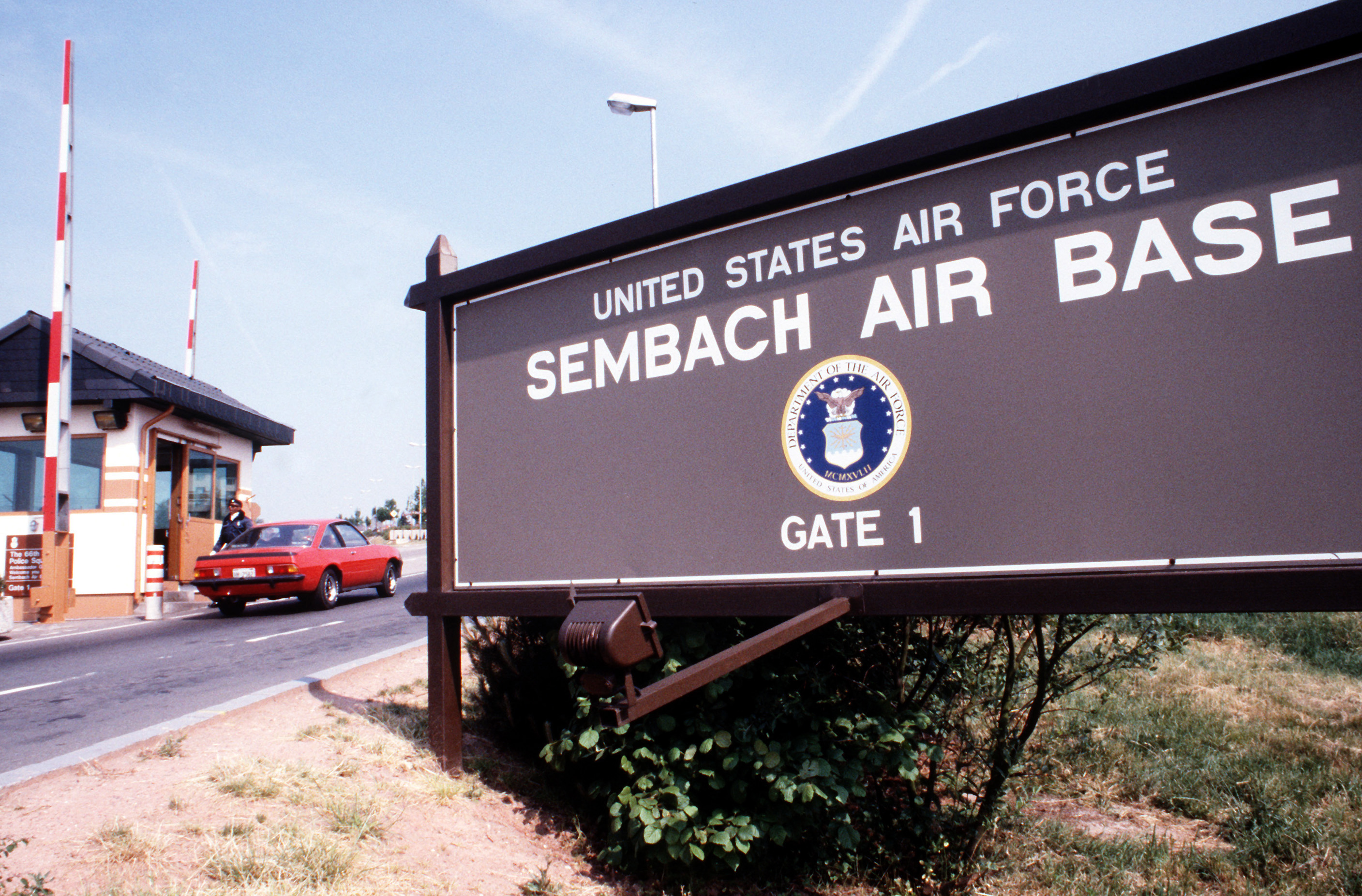
In the spring of 1989 we were notified that the move from Boerfink to Sembach would commence. We were all very excited, not only would I no longer have to work in a dark, underground windowless office, but rather in a bright, sunny, modern office at HQ 17th United States Air Force, but the shift guys would get the newest, most sophisticated computer and radar equipment available at the time. Rumors had it, that each of the five stations cost more than 20 Million Dollars.
The ops room of course still had to be in a secure, bomb proof facility under ground, and the Sembach bunker, no longer in service as of today, was right under the football field. The entrance rather inconspicuous right next to the grandstand.
A sector operations center was comprised of five stations. Each station was manned by an officer and his or her "tech", an NCO. When you entered the new ops room, you immediately faced the SAM station, or Surface-To-Air Missile station, which monitored air defense systems available to fight off any intruders in the air from the ground. Next to SAM was the Fighter station, commanding all subordinate fighter units capable of fighting off intruders in the air. Every now and then I would fill in for the fighter tech and was able to conduct a "training scramble", which means, I radioed one of the tactical fighter wings within our sector, and ordered them to conduct an aerial interception with two fighter jets for training purposes, a so-called Tango- or T-Scramble. Within minutes two jets would take off from one of the four tactical fighter wing bases under SOC3 command, Bitburg, Spangdahlem, Ramstein or Hahn. Each unit had a call sign, I can't remember the ones for the air bases, but we were Copper Ring, the Boerfink CRC was Hard Tire, the CRC at Lauda was Straw Basket, and SOC4 at Messstetten was Sweet Apple. So you would call the base via radio by its call sign, and specify "Tango Scramble" along with coordinates, altitude and other information needed for the pilots to find their - in this case - imaginary targets. This was exciting stuff, vital to Europe's air defense during a most unstable time of the cold war (no one knew what the Soviets would do about the uprisings going on throughout most of the Warsaw Pact countries, such as Hungary, Czechoslovakia, Poland, even East Germany), and I was right there in the smack middle of it.

I remember the Intel station, gathering information from NATO intelligence services, including the German BND and the American CIA, but mostly from military intelligence agencies such as MAD, the Air Force's ISR, the British DI and so forth.
Then there was the emergency action station. During peace time my main job was to maintain, control and register all classified materials received, sent out, handled or held by SOC3. This included among many other documents the top secret NATO encryption code handbook, containing all the encryption and decryption keys used in radio communications. In case of war, or during exercises, I was the Emergency Action Technician, responsible for receiving encrypted orders from SHAPE, the Supreme Headquarters of Allied Powers in Europe, decrypt them, relay them to the Sector Controller, wait for his response, encrypt the response and respond with the encoded message or forward it to our subordinate units. Since I was in charge of NATO's most secret documents, I sometimes carried a sidearm as protection, especially when transferring classified documents between bases.
The Sector Controller being in charge of it all would sit and monitor everything, and ultimately had the supreme command over any subordinate air defense units within the sector.
Being the most sophisticated of all the SOCs in Europe, we also became the show-off Sector, meaning periodic visits by dignitaries, such as NATO commanders, parliamentary oversight and appropriation committees, and other politicians. Often enough we had Generals, Senators, Congresspeople and what not enter the ops room, admiring the equipment and exchanging the occasional few words with the crew.
This is a picture from the 601st Air Operations Center at Tyndall AFB, Florida. It illustrates pretty much, what our fancy new ops room looked like (minus the flat screens, but we did have color monitors):

